
ESG is not painting the logo green

Updated: Sep 10

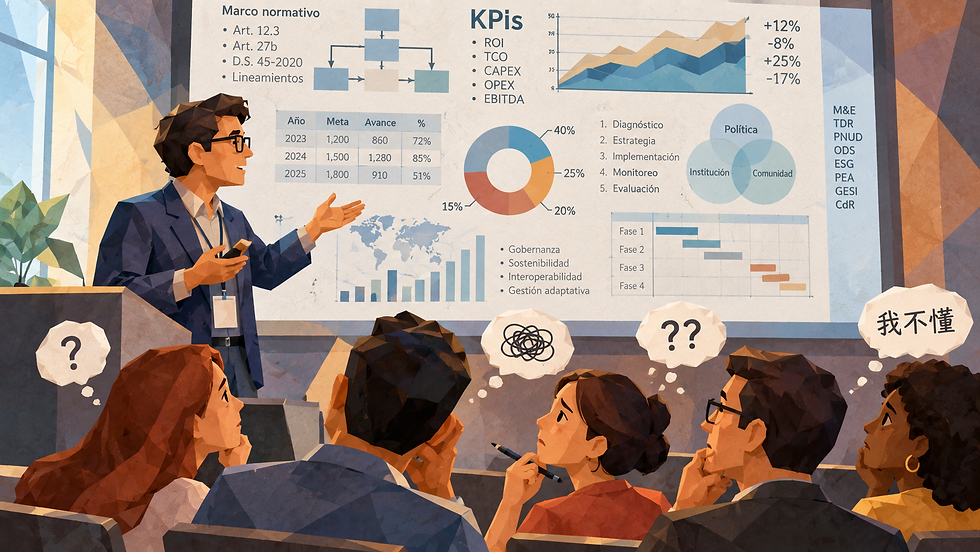
ESG is one of those acronyms that appear more and more in reports, business meetings and LinkedIn publications, almost always assuming that everyone knows what it means. The reality is different: many people have heard it, but few could explain it clearly.
It comes from the English Environmental, Social and Governance: in Spanish, environmental, social and governance criteria. In short, it serves to see how an organization relates to the planet, to people and to the way it makes decisions.
The E is environmental: energy and water consumption, waste management, emissions, pollution, climate change, use of natural resources. The S is social: working conditions, diversity, health and safety, human rights, relationship with communities, treatment of suppliers, impact of products or services on people. The G is governance: who decides, how it is supervised, what controls exist, how corruption is prevented, how transparent the organization is and whether it is accountable.
It's not an inventory of good intentions. It is also not planting trees once a year, posting volunteer photos or painting the logo green during an environmental campaign. ESG seeks to see how those issues are really involved in strategy, operations and decisions, including contradictions. A company can announce that it has reduced plastic in its offices (good for it), but that says little about its environmental performance if at the same time it consumes huge amounts of water or works with suppliers who violate environmental standards. The same with the social: you can finance community projects and maintain poor working conditions indoors. And in governance, you can have an impeccable code of ethics on paper and no reliable mechanism to report irregularities.
Is it the same as corporate social responsibility? Not exactly.
CSR is usually associated with voluntary programs or commitments with which an organization seeks to contribute to social and environmental well-being. ESG takes some of those issues, but connects them with risk management, indicators, supervision and accountability. The line between the two is not always clear and they can coexist without problem, but ESG puts more emphasis on demonstrating what is being done, how it is measured and who is responsible for the results.
For that there are international frameworks. GRI Standards help organizations report their impacts on the economy, the environment and people. The IFRS S1 and IFRS S2 standards, on the other hand, focus on the sustainability risks and opportunities that can affect the finances of a company, with a specific standard for the climate issue. That is why there is not a single way to talk about ESG: some start from the impact that an organization causes on society and the environment, others from how those factors affect its financial performance. They are related, but they are not the same.
Where does communication come in?
Here it is convenient to clarify something: communicating is not turning loose actions into a beautiful story.
When taken seriously, communication comes in from before publishing any report. It helps to identify stakeholders, listen to their concerns, explain decisions, organize information and tell progress and difficulties in an understandable way. An ESG strategy needs communication to connect areas that normally work separately: Human Resources knows about diversity and working conditions, Operations knows energy consumption, Finance manages risk data, Purchasing relates to suppliers, management decides and supervises. If each area keeps its information on its side, the result is scattered data, messages that contradict each other, and an incomplete photo of the real impact. Communication can order that dispersion into a coherent narrative, provided that that narrative is backed by evidence.
It also has a listening function. Communities, staff, customers and suppliers are not only public who must be warned: they are sources that can warn risks, point out impacts that the organization is not seeing and question decisions. Listening is not opening a survey to fulfill the file. It is to have mechanisms for dialogue, to answer what is raised and to explain what was decided from that conversation.
And there is a translation function. Sustainability reports are usually loaded with indicators and technical terms, and communication has to make them understandable without deforming them. It's not about hiding the complexity, but about explaining what the data means and why people care. To say that a company reduced its emissions by 15% sounds good, but responsible communication should clarify what the reference year was, what activities were included, how it was measured and if the decrease was due to real improvements or simply that production fell. Without that context, the percentage impresses and says very little at the same time.
This is where the risk of greenwashing appears: when an organization exaggerates or selectively presents its environmental actions to appear more responsible than it is. It also happens in the social, for example when a company talks about diversity while maintaining discriminatory practices. The problem is not communicating the advances, but using communication to cover them up. A serious organization does not need to present itself as perfect; it needs to say what it has achieved, what it has not achieved, what its challenges are and what it is going to do with them. Recognizing a difficulty usually generates more confidence than filling a report of smiling photos and phrases that no one can verify. That's why those who work in communication have to ask uncomfortable questions: where does this data come from?, who verified it?, what period does it cover?, do we also show what went wrong?, did the affected people participate?, can this be proven? Those questions do not slow down communication. They take care of her.
Communication inside doors
Sustainability commitments are announced outwards, but are fulfilled or breached internally. Staff need to understand what those commitments mean in their day-to-day work. An environmental policy is of little use if Purchasing continues to choose suppliers only for price. A human rights commitment loses weight if those who supervise equipment do not know how to prevent harassment. And a code of ethics is not worth much if no one knows the complaint channels, or is afraid of them.
That's where knowledge management comes into play. It is not enough to produce information: you have to organize it, save it, share it and use it to decide better. The learnings of a project, the consultations with communities, the reported incidents, the solutions that worked, all that should remain in the institutional memory instead of disappearing when the team changes or a consultancy ends.
ESG may sound like a topic reserved for large companies and investors, but the underlying questions are quite close: what impact does an organization produce, who benefits or harms, how it decides, who supervises it, what he does when he makes a mistake, how he shows what he says. Communication helps to raise those questions, listen to the answers and make them understandable, but its most valuable contribution is not to improve the image of the organization. It is to help that there is coherence between what he says, what he does and what he can prove.
If ESG stays in a nice report, it probably ends up archived on a website that almost no one visits. If you get involved in the decisions, culture and learning of the organization, you can become a real tool for managing impacts and building trust. And trust, even if it does not appear as a box on a spreadsheet, is still the most difficult to build and the easiest to lose.


Comments