
In an age of distraction, the challenges of reporting are threefold: technological, attentional and communicative.


For a long time we thought that the big problem was access to information. That if people had more data, more channels and more technology, they would be better informed.
Today the problem seems to be the opposite: there is too much information, what is missing is attention.
We live surrounded by screens, notifications, messages, alerts, short videos, urgent headlines and simultaneous conversations. The cell phone became an extension of daily life, but also an open door to constant noise. We check news, answer messages, check social networks, work, learn and distract ourselves from the same device.
Technology brought us closer to information, but it also fragmented our ability to focus on it.
And there appears a huge challenge for communication: how to report when people are saturated?
It is not enough to publish more, or to repeat a message on all available channels. Many organizations still believe that communicating is producing more content: more newsletters, more campaigns, more posts, more emails, more videos. But in an environment of permanent distraction, more information does not always mean better communication. Sometimes it means more noise.
Strategic communication should do the opposite: help to order, prioritize and make sense.
Informing well is not throwing data into the air. It is to understand what a person needs to know, at what time, with what level of depth and why they should care. It is to transform scattered information into clear, useful and understandable messages.
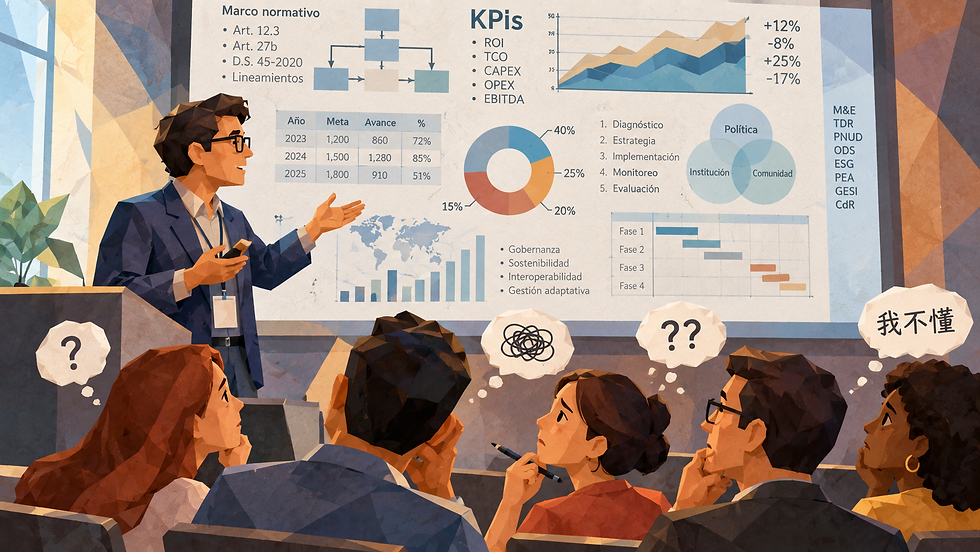
It also implies recognizing that attention is limited. People don't always have time, energy, or willingness to read extensive documents, interpret technical language, or connect loose pieces of information on their own. Therefore, communicating well is not simplifying for comfort, it is facilitating understanding.
In times of distraction, clarity becomes a form of respect. This applies to a public campaign, an institutional strategy, an internal communication, a development project or a knowledge management initiative. If the message fails to capture attention, generate understanding and guide an action, it is probably lost in the endless flow of content.
But attracting attention should not be confused with manipulating emotions or falling into sensationalism. That is another risk of our time: competing for visibility using fear, anger or exaggeration. It can work for a few seconds, but it doesn't necessarily build trust.
Communication that only seeks to attract attention can become a spectacle. Communication that seeks to generate understanding can become knowledge.
Therefore, the challenge is not only technological, it is also ethical and strategic. We need to think better about how we communicate: what we say, what we omit, how we order information, what channels we use and what experience people have when they try to understand a message. The question is no longer just "how do we get to more people?", but "how do we help people understand better?"
This is where knowledge management becomes relevant, because it is not just about producing information, but about making that information accessible, useful and usable. A saved document, a lost publication or an incomprehensible database do not necessarily generate learning.
Knowledge needs communication to circulate, and communication needs criteria not to become noise.
Technology will continue to advance. We will have more tools, more platforms and possibly more artificial intelligence organizing, producing and distributing content. But the underlying challenge will remain human: to ensure that important information is not lost among so many distractions.
Reporting in these times requires clarity, empathy and purpose, because attention has become one of the scarcest resources. And communicating well, today more than ever, means respecting that resource.


Comments