
Communication, algorithms and the complexity crisis

Updated: Aug 27
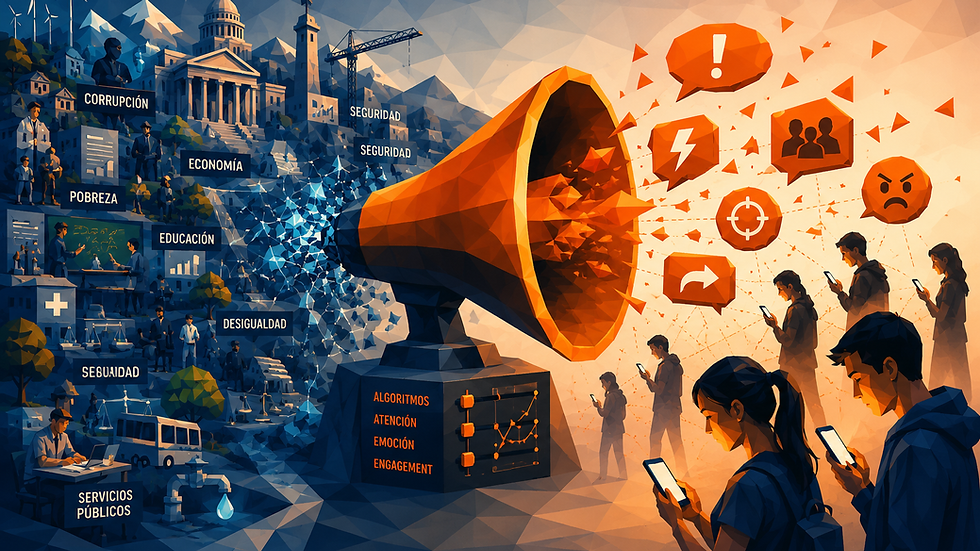
The complexity of current communication
We live in a time when a message that points to an enemy usually travels faster than an explanation that tries to solve a problem. A thirty-second video promising a simple solution to a complex economic crisis can reach millions of people before a technical report has been read by a few hundred. Phrases like "they are the problem" have more communicative power than explanations about inequality, weak institutions, public policies or structural problems accumulated over decades.
I have worked in communication for more than twenty years. My experience includes international development, public health, behavior change and evidence-based communication. What I observe in the current political ecosystem worries me. It is not a left or right-wing phenomenon, but I understand the communication mechanisms behind it.
We are experiencing a clash between two worlds: a reality that is inevitably complex and a digital ecosystem that rewards the simplest, most emotional and easy-to-share messages.
The influence of social networks
This phenomenon did not start with social networks. Political communication has always been marked by emotions, identities and narratives. As Drew Westen explains in The Political Brain (2007), people don't process political messages like cold analysts who compare data and make purely rational decisions. Emotions, values, identities and a sense of belonging are central elements in how we interpret reality.
This is important because a false dilemma between emotion and reason often arises. The problem is not that politics has emotions; it has always had them. Hope, indignation, fear or the desire for change have been drivers of social mobilization throughout history.
The problem appears when a communication environment is designed to reward those emotions that generate the most immediate reaction.
Social networks are not neutral spaces where all ideas compete under the same rules. Digital platforms have changed political communication by creating new logics of visibility, interaction and participation. As Papathanassopoulos and Giannouli (2025) point out in Political Communication in the Age of Platforms, current political communication is deeply influenced by platforms whose algorithmic design determines which messages reach, to whom and with what intensity.
An algorithm does not ask if a message is true, fair or useful to society. His main question is usually much simpler:
Does this generate a reaction?
Does it make a person stop?
Comment?
Share?
Stay longer on the platform?
If the answer is yes, that content is more likely to be amplified.
Truth and virality
Here appears one of the most uncomfortable parts of the conversation. The truest thing doesn't always go viral. The most useful thing doesn't always go viral either. Often, what goes viral is what generates a more intense emotional reaction.
This is not just an intuition. A study published in Proceedings of the National Academy of Sciences found that messages expressing animosity towards opposing political groups generate significantly higher levels of interaction on social networks (Rathje et al., 2021).
In simple terms: messages that have a clear enemy usually have a competitive advantage in the attention economy. But it would be a mistake to fall into another simplification and affirm that everything is the fault of the algorithms. That argument would be, ironically, another example of how we seek simple answers to complex problems.
The research of Metzler and collaborators (2023) proposes a more interesting vision: there is a feedback cycle between human motivations, social incentives and digital recommendation systems.
Algorithms don't invent our anger, our fears or our frustrations. They work with them. They amplify emotions that already exist and turn them into an extremely efficient distribution infrastructure.
Social frustration and political narratives
Social frustration is often legitimate. Corruption exists. Inequality exists. Insecurity exists. Inefficient bureaucracy exists. Many people have real reasons to feel that institutions do not respond to their needs.
The problem is not the existence of that frustration. The problem is what happens when that frustration enters a communication system that rewards simplicity over complexity.
An explanation of why an economy does not grow may require talking about productivity, education, investment, corruption, international markets and public policies. A viral message can summarize everything in five words:
“They are the ones to blame.”
And that message has a huge competitive advantage. Not because it is necessarily true or false, but because it is easier to remember, share and turn into a collective identity.
Transformation of frustrations into powerful narratives
In that space of frustration is where the most effective political actors appear from the point of view of communication. Not necessarily because they have discovered new problems. Many times what they do is something much more sophisticated: they identify a real frustration, turn it into a simple story, assign clear managers and offer an immediate solution.
From the perspective of political communication, this is not something new. Manuel Castells, in Communication and Power (2009), argues that power in contemporary societies is largely disputed in the ability to build meanings in people's minds. Whoever manages to define how a society interprets a problem has a huge political advantage.
A complex problem can quickly become a simple story:
“Corruption is the fault of these politicians.”
“Insecurity exists because this group is responsible.”
"The country is bad because someone stole our future."
The strength of these messages is not necessarily that they are completely false. Often, they start from a real experience of frustration. Corruption can exist. Insecurity can be a legitimate concern. Inequality can be evident.
The problem arises when a complex phenomenon is reduced to a single enemy and a solution is presented that promises to be immediate. This does not happen only in one ideological extreme.
Political history is full of movements from different currents that have used the construction of a "we" against a "they" to mobilize support. What changes today is the speed and scale with which these narratives can circulate.
Communication on platforms has changed the rules of the game. A message that could previously be limited to a speech in a square or on the cover of a newspaper can now be repeated millions of times, personalized by algorithms and reinforced within digital communities.
This has a particularly important effect on the new generations. An 18-year-old did not necessarily live the successes or failures of the leaders and political movements that today return to the stage. His political experience is mediated by the content he consumes on his phone: a thirty-second video, a meme, a viral comment, an emotional narrative.
That doesn't mean that young people are less critical or less intelligent. It means that they are forming their vision of the world within a completely different information ecosystem. That ecosystem favors speed over reflection, reaction over analysis and, many times, emotion over context.
The challenge of governing in the digital age
But the problem does not end when these movements come to power. Here a fascinating communicational paradox appears: the most effective messages to capture attention are not always the most effective to govern.
Governing means managing complex systems. It means negotiating opposing interests, working with imperfect institutions, handling economic restrictions and accepting that some changes take years or even decades.
Reality does not disappear because a message has gone viral. Structural problems are not solved with a slogan.
Then, a new challenge arises: when simple promises face complex realities, governments have two paths. They can recognize complexity, communicate limits, explain progress and accept mistakes. Or they can duplicate the original strategy and look for new enemies that keep the narrative alive.
The second option is often chosen because, communicationally, it still works. That is the risk of the current cycles of radicalization. They don't necessarily function like a pendulum where society automatically returns to a break-even point. In some contexts, they can function more like a downward ladder where every frustration feeds the search for an even simpler, faster and more extreme solution.
The big question of our time is how we communicate complexity in an environment that rewards simplification.
How do you explain that a public policy can take ten years to show results when a thirty-second video promises to solve everything?
How do you communicate uncertainty without seeming incompetent?
How do you recognize an error without being used as proof that the whole project has failed?
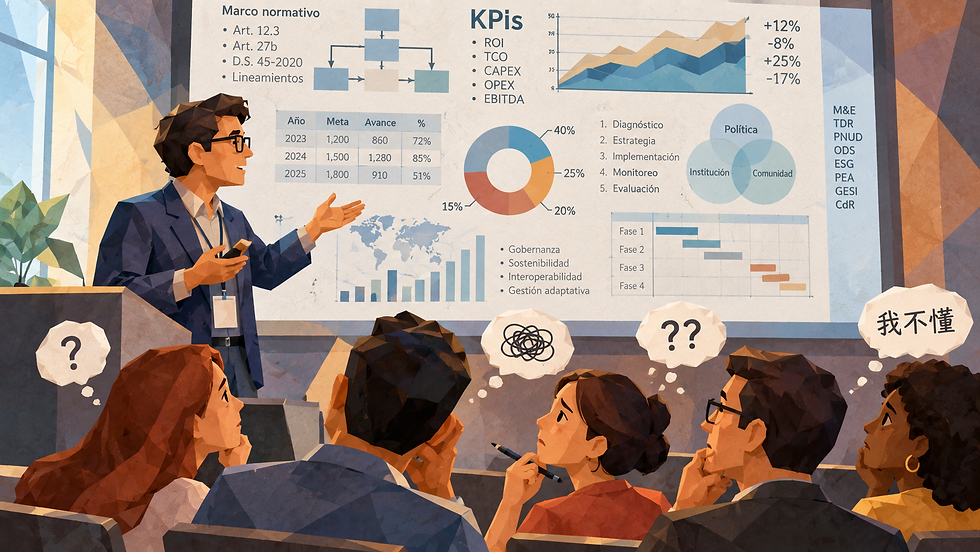
This is a question that international development work knows well. Changing behaviors, strengthening institutions or transforming communities has never been an instantaneous process. It requires listening, building trust, documenting progress, recognizing failures and telling honest stories about processes that are almost always gradual.
Perhaps the big mistake of many institutions has been to believe that the results speak for themselves. They don't.
The results should be translated into stories that people can understand, relate to their daily lives and critically evaluate.
The solution cannot be to abandon the emotion and return to a cold communication based only on data.
Emotion will always be part of politics and the challenge is much more difficult: building narratives that combine emotion with honesty, hope with evidence and simplicity with responsibility. Because if the only actors capable of communicating effectively are those who offer simple enemies for complex problems, then the problem will not be just political.
Recommended readings:
Westen, Drew (2007). The Political Brain: The Role of Emotion in Deciding the Fate of the Nation. Public Affairs. * An analysis of how emotions, identities and narratives influence political decisions. Westen questions the idea of the purely rational voter and shows that the most effective political messages connect with values, fears, hopes and a sense of belonging.https://www.uvm.edu/~dguber/POLS125/articles/westen.pdf&ved=2ahUKEwiNrduc8JGVAxWoTTABHU_PK1QQFnoECB0QAQ&usg=AOvVaw0J5PvJb8-Fu1GmzJQ1U9G4
Castells, Manuel (2009).Comunicación y poder. Madrid: Alianza Editorial.* Una obra fundamental para entender cómo el poder se disputa mediante la capacidad de construir significados en la sociedad. Castells analiza el papel de los medios, Internet, las emociones y las narrativas en la formación de la opinión pública y los conflictos políticos contemporáneos. https://docs.google.com/file/d/0B-aY1ynFcpHbelFFT1NrZFZrN0k/view?resourcekey=0-9Nzh14ZQG-BNL_ZxgHkWdg
Papathanassopoulos, Stylianos & Giannouli, Iliana (2025).Political Communication in the Age of Platforms. Encyclopedia, 5(2).* Analiza cómo las plataformas digitales están transformando la comunicación política, las campañas electorales y la participación ciudadana, generando nuevas tensiones relacionadas con la personalización algorítmica, la polarización y la fragmentación del espacio público. https://www.mdpi.com/2673-8392/5/2/77?utm_source=chatgpt.com
Rathje, S. et al. (2021).Out-group animosity drives engagement on social media. Proceedings of the National Academy of Sciences (PNAS).* Demuestra que los mensajes que expresan hostilidad hacia grupos opuestos generan mayores niveles de interacción en redes sociales, ayudando a explicar por qué la indignación puede convertirse en una ventaja competitiva dentro de la economía de la atención. https://www.pnas.org/doi/10.1073/pnas.2024292118?utm_source=chatgpt.com
Metzler, H. et al. (2023).Social Drivers and Algorithmic Mechanisms on Digital Media.* Propone que los algoritmos no operan de manera aislada, sino en un ciclo de retroalimentación con las motivaciones humanas, las dinámicas sociales y los incentivos de las plataformas digitales. https://pmc.ncbi.nlm.nih.gov/articles/PMC11373151/?utm_source=chatgpt.com


Comments